
Updated November 2026
Brand marketing and performance marketing are often set up as a choice: spend on the brand, or spend on what you can measure. That framing causes a lot of bad budget decisions. The two do different jobs, and one depends on the other.
This guide explains what each does, how they fit into the funnel, why consistency in upper-funnel spend matters more than it usually gets credit for, and how to decide the balance for your brand.
The short answer
Brand marketing creates demand. It builds awareness, familiarity and preference, so more people in your audience know you and want what you sell.
Performance marketing converts demand. It uses paid channels you can measure, such as search and social ads, to turn people who are ready to act into customers.
You need both, and the order matters. Performance marketing can only convert the demand that exists. Brand marketing is how you keep creating more of it.
What each one does
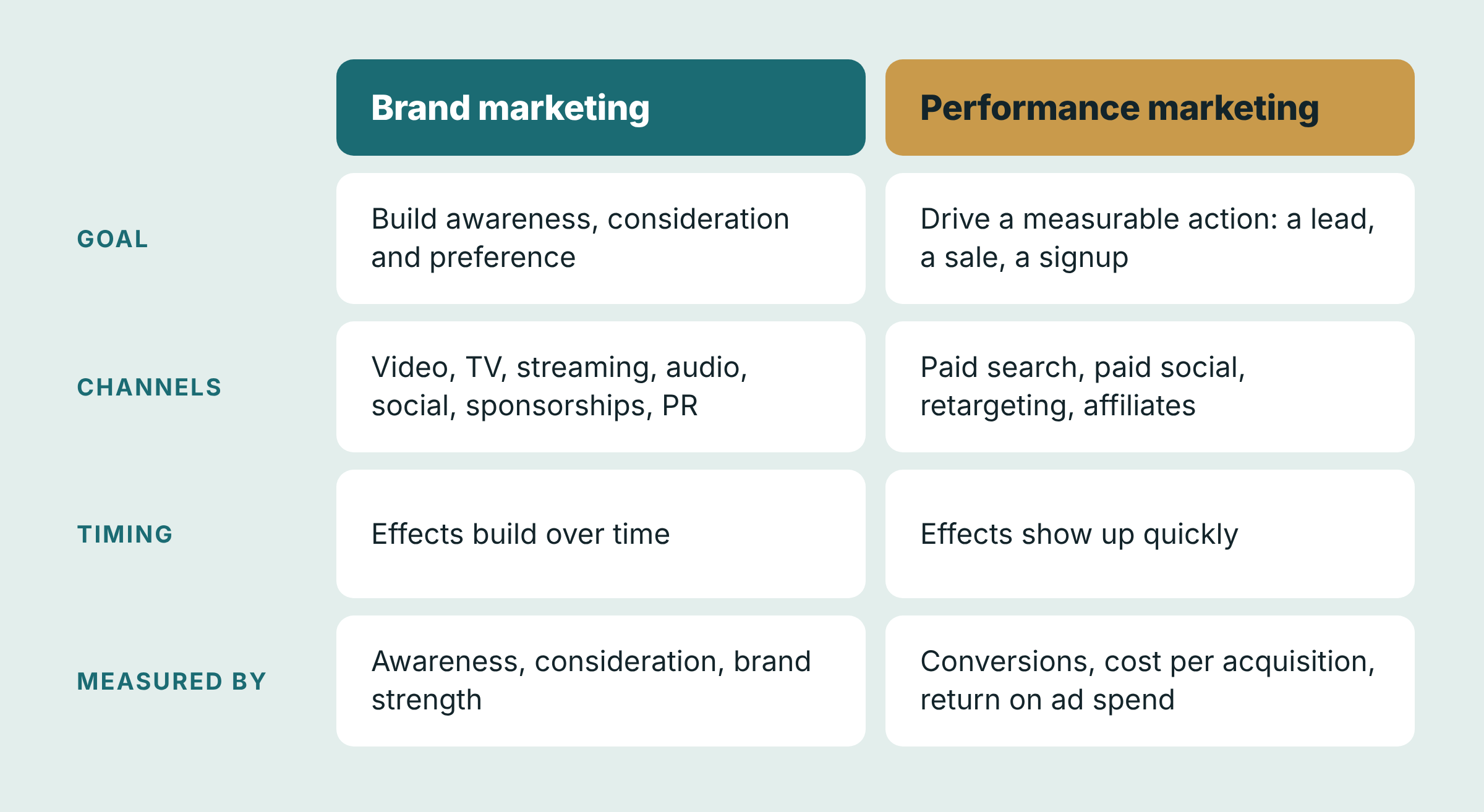
Brand marketing vs. performance marketing: goal, channels, timing and how each is measured
Brand and performance across the funnel
It helps to think of three stages:
Upper funnel: reach and awareness. Getting in front of your addressable audience so they know you exist.
Mid funnel: education and consideration. Helping people understand what you offer and why it’s right for them.
Lower funnel: conversion. Turning people who are ready to buy into customers.
Brand marketing does most of its work in the upper and mid funnel. Performance marketing does most of its work at the bottom. All three need to be working together to get the best results. A strong lower funnel with nothing feeding it runs out of people, and a strong upper funnel with a weak lower funnel loses the people it attracts.
Why consistent upper-funnel spend matters
The effect of brand spend accumulates. Each month of consistent awareness work adds to what people already know and feel about you, and that builds over time before it shows up in conversion. Stopping and starting doesn’t give it the chance to accumulate. You pay for the awareness, then lose it before it compounds.
I saw this most directly in education, where I’ve talked with a number of CMOs in the sector. They describe the same thing: when upper-funnel spend is consistent, they see a positive lift in conversion. Some told me they put up to 50% of their working media into upper-funnel brand. Those are practitioner observations, not a published benchmark, and the right split depends on your category, your stage and how well known you already are.
The reallocation mistake
The temptation shows up when a business is behind plan. The upper funnel is harder to tie to this month’s results, so it looks like the easy place to cut, and the money moves to lower-funnel channels that promise faster conversions.
In my opinion, that’s a mistake. You have to create demand to convert demand. If you cut demand creation, you’re converting off the demand that already exists, and it erodes over time. Conversion rates can look fine for a while, because the awareness you built earlier is still carrying the results. Then the pipeline thins, and by the time it shows up it takes longer to rebuild than it took to cut.
Reach a critical mass of your audience
The question to ask about brand spend is whether it’s reaching enough of your addressable audience to matter. Awareness works when a critical mass of the people you want to reach know who you are. Spread too thin across too many audiences or too many months, the spend doesn’t add up to anything people remember.
That’s also why consistency and focus go together: define the audience you need to reach, fund reaching them steadily, and hold that level through the dips.
How to set the balance
There’s no single right ratio, but you can work from these questions:
How well known are you in your addressable audience? Low awareness points toward more upper-funnel investment. High awareness with weak conversion points toward the middle and lower funnel.
Where is the funnel leaking? Use your numbers to see whether the problem is too few people entering, too few considering, or too few converting.
Are your conversion costs rising? If you keep paying more to convert the same audience, the pool of ready buyers may be shrinking, which is a sign that the top of the funnel needs attention.
What does your category require? Long considerations and high-stakes purchases often need more education and consideration work than quick, low-cost ones.
Can you hold the level? Choose a brand investment you can sustain through a bad quarter, since consistency is the point.
How to know if brand spend is working
Brand effects are harder to see than clicks, so measure them directly. A brand tracking study shows whether awareness and consideration are moving among your target audience, and whether the strength of the brand is growing. See Brand Tracking Study: What to Measure and How to Use It for the measures I’d start with, and read the results alongside conversion data, not in place of it.
Common mistakes
Cutting brand spend to hit this quarter’s plan. The cost shows up later and takes longer to repair.
Judging upper-funnel spend by last-click results. It isn’t built to convert on the spot.
Starting and stopping. Pulses of spend that never reach a critical mass of your audience tend to be forgotten.
Treating the funnel as three separate budgets. Upper, mid and lower funnel work as one system.
Copying another company’s split. A ratio that works for a well-known brand can be wrong for one still building awareness.
When to run it yourself and when to get help
If you have a clear read on your funnel and the discipline to hold the investment, you can set the balance in-house. Outside help is most useful when you need a clear view of where the funnel is breaking, a plan for the brand that your leadership team will fund and keep funding, and a way to measure it. That’s part of the work I do in Grow, which covers brand and performance in one funnel.
If you’d like to talk through your own mix, book a 30-minute consultation.
Frequently asked questions
What’s the difference between brand marketing and performance marketing? Brand marketing builds awareness, familiarity and preference over time. Performance marketing drives measurable actions, such as leads or sales, through paid channels.
Which is better, brand or performance marketing? They do different jobs and work together. Performance marketing converts existing demand, and brand marketing creates new demand.
How much should I spend on brand vs. performance marketing? It depends on how well known you are, where your funnel is leaking and what your category requires. Some CMOs in education told me they put up to 50% of working media into upper-funnel brand, but treat that as one observation, not a benchmark.
Is it a mistake to cut brand spend when I’m behind plan? In my opinion, yes. Cutting demand creation means you convert off existing demand, which erodes over time. Consistent upper-funnel spend needs time to accumulate.
What are the stages of the marketing funnel? Upper funnel is reach and awareness, mid funnel is education and consideration, and lower funnel is conversion.