
Updated November 2026
A brand tracking study is a survey you repeat over time to see how people perceive your brand and your competitors. The standard version tracks awareness, consideration and purchase, and that’s a fine place to start. But those measures can leave you with a dashboard that shows where you are without showing why you’re winning or losing.
This guide covers the core metrics, then what we added on one of the world’s most iconic entertainment franchises to get a sharper read: a blended brand power metric, a better way to ask about salience, and heartshare questions that separated brands that affinity scores couldn’t.
What a brand tracking study is
You survey the same kind of audience, with the same questions, in regular waves. Because the questions stay constant, any change from one wave to the next reflects a real shift in how people see you. A good tracker answers questions like these:
Is awareness growing, and among whom?
Are more people considering us?
How do we compare with competitors?
Did that campaign move anything?
Brand tracking metrics: the funnel basics
Most trackers start with a funnel. Labels vary, but the core measures are:
Awareness: do people know the brand? Unaided awareness asks people to name brands in the category with no prompts. Aided awareness shows a list and asks which they recognize.
Consideration: would they consider buying it?
Preference: which would they choose first?
Usage: have they bought it recently?
Advocacy: would they recommend it?
These tell you how many people know and would buy. They don’t tell you how strongly people feel, or what’s driving the numbers. That’s where the rest of this guide comes in.
Go beyond the funnel: build a brand power metric
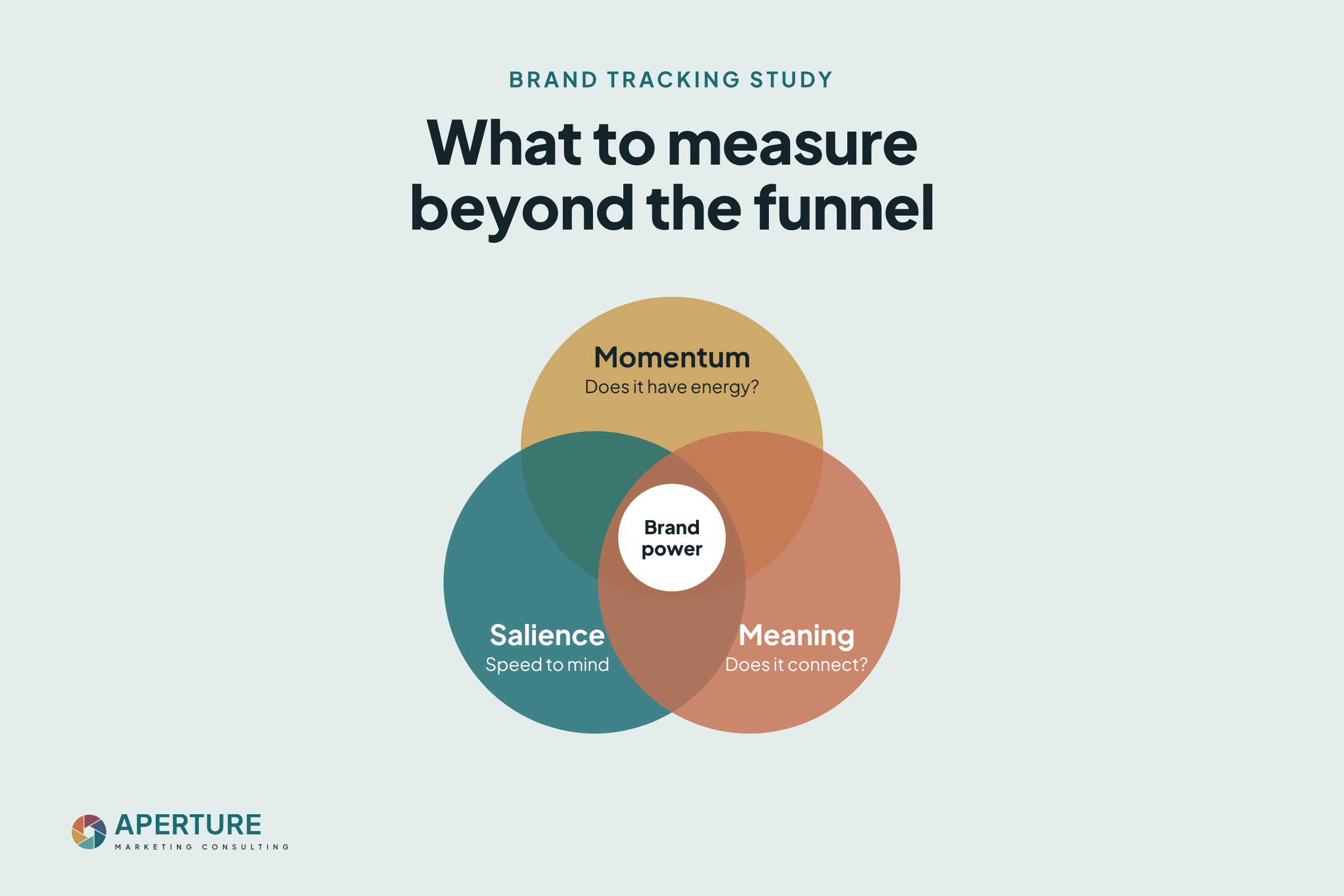
On one of the world’s most iconic entertainment franchises, we created and implemented a blended metric called brand power. It combined three things:
Momentum: does the brand have energy? We asked about excitement for what comes next, with the statement “I am excited to see what comes out next.”
Salience: how quickly does it come to mind? We used two questions: “It plays the biggest role in my life” and “I’m thinking about it.”
Meaning: does it connect? We asked whether the brand “has stories and characters I enjoy and am interested in watching.”
Each of the three was weighted by category. Our research agency used advanced analytics to determine the right weights for entertainment, since what drives a brand’s strength differs from one category to another. The franchise ranked number one in brand power among the major global franchises we tracked.
You can use the same frame in your own category. Keep momentum, salience and meaning as the three dimensions, rewrite the questions for your brand, and have your research partner work out the weights. A statement like “I am excited to see what comes out next” becomes “I’m excited to see what this brand does next.”
How to ask about salience
Salience is speed to mind, or top-of-mind awareness. How you ask matters.
We asked it unaided, with no logos shown, as an open-ended question: “Which entertainment brand or franchise plays the biggest role in your life?”
That wording gets a truer read than “which brands can you name?” A list of names tells you what people recall. This question tells you which brand is most resonant in their lives, and it gives you a real top-choice read on who comes first.
Add mindshare and heartshare
We also introduced two concepts that I’d recommend to anyone building a tracker.
Mindshare is how much a brand occupies people’s thoughts. We asked two questions: “I think about it often” and “I look forward to immersing myself in it” (or escaping into it). Our franchise ranked number one.
Heartshare is how much a brand matters emotionally. We asked two questions: “Would miss greatly if it went away” and “Means more to me than just entertainment.”
Heartshare got at far more than the usual like-or-love affinity question, which we asked as well. When we looked at affinity, the franchises bunched at the top, and it was hard to find differences in top-two-box like or love. The heartshare questions produced more separation. If your affinity scores all look similar, this is the likely reason, and heartshare is the fix.
Report purchase intent alongside brand power
We also asked purchase intent and reported it next to brand power, because it captures the likelihood of asking for or buying a franchise’s products over the next 12 months. Brand power tells you how strong the brand is. Purchase intent tells you whether that strength is turning into commercial action. You need both to see the whole picture.
Track quality and freshness
I also added a quality and freshness look with two questions: “Always delivers with the highest quality and excellence” and “Is always coming out with something new and fresh.”
Our analytics showed that delivering with the highest quality and excellence was a top driver of brand power. That’s the value of putting these questions in the tracker. A score tells you where you stand. A driver analysis tells you what to protect and invest in.
Add attitude questions to find your true superfans
The last addition was a set of attitudinal questions that let us segment fans and identify true superfans. It’s a big enough topic to have its own guide: Attitudinal Segmentation: How to Find Your Real Fans.
How to run a brand tracking survey
A few principles hold up regardless of category:
Keep the questions constant. If you reword a question between waves, you can’t tell whether people changed or the question did.
Include your competitors. A score means little without a comparison. Brand power and heartshare both mattered because we could see the franchise against others.
Match the weights to your category. Don’t borrow another category’s formula.
Decide how often to run it based on how fast your market moves. Whatever the cadence, stay consistent from wave to wave.
Work with a research partner on the analysis. Weighting and driver analysis need the right statistical approach.
Brand tracking questions: a starter set
These are the items from the work above. Rewrite them for your category.
Salience (ask unaided, open-ended) - Which [category] brand plays the biggest role in your life? - It plays the biggest role in my life. - I’m thinking about it.
Momentum - I am excited to see what comes out next.
Meaning - Has stories and characters I enjoy and am interested in watching.
Mindshare - I think about it often. - I look forward to immersing myself in it.
Heartshare - Would miss greatly if it went away. - Means more to me than just entertainment.
Purchase intent - How likely are you to ask for or buy products from this brand over the next 12 months?
Quality and freshness - Always delivers with the highest quality and excellence. - Is always coming out with something new and fresh.
Attitudes and identity (for segmentation) - Proud to be a fan of - Represents values important to me - Community of fans I want to be a part of
From dashboard to decisions
A tracker earns its cost when it changes what you do. Three ways to use it:
Use driver analysis to decide where to invest. If quality is your top driver, protecting it matters more than a new campaign.
Compare brand power with purchase intent. Strong brand power with weak purchase intent points to an offer, price or availability problem. Weak brand power points to the brand itself.
Use heartshare to find your most committed customers, and then learn what they value. They’re your compass for what to protect as the brand grows.
Common mistakes
Relying on affinity alone. Like and love scores can bunch together and hide real differences.
Prompting salience. Showing logos or lists measures recognition, not resonance.
Using one formula for every category. What drives a brand’s strength varies, so weights need to be set for your category.
Treating purchase intent as a separate report. It belongs next to brand power.
Collecting numbers without a decision behind them. Decide in advance what change would make you act.
When to run it yourself and when to get help
If you already have a research team, you can add these questions to an existing tracker. Outside help pays off when you’re designing the metrics, setting up the analysis, and turning the results into a strategy your leadership team backs. That’s the work I do in Decide, my brand strategy and positioning service.
If you’d like to talk through your tracker, book a 30-minute consultation.
Frequently asked questions
What is a brand tracking study? It’s a survey repeated over time with consistent questions, so you can see how perceptions of your brand and competitors change.
What’s the difference between brand tracking and brand health tracking? The terms are often used interchangeably. Some people use brand health tracking for a broader set of measures, including perceptions and attitudes, beyond the awareness-to-purchase funnel.
How often should I run a brand tracking study? It depends on how fast your market moves and how often you make brand decisions. Choose a cadence you can keep, and keep the questions the same from wave to wave.
How do I measure brand awareness? Ask unaided first, with no prompts, then aided with a list. To go further, ask which brand plays the biggest role in people’s lives, which measures resonance and not only recall.