
Updated November 2026
Two customers can buy the same products, in the same amounts, as often as each other, for completely different reasons. Purchase data can’t tell them apart. Attitudinal segmentation can. This guide explains what it is, how to build one, and what it found on one of the world’s most iconic entertainment franchises.
What attitudinal segmentation is
Attitudinal segmentation groups people by what they believe and feel, especially about your brand and your category, instead of only by who they are or what they buy. It helps to see it next to the other common lenses:
Demographic: who people are, such as age, income and location.
Behavioral: what people do, such as what they buy and how often.
Psychographic: lifestyle, interests, personality and values.
Attitudinal: what people think and feel about your brand and category.
Psychographic and attitudinal segmentation overlap heavily, and many people use the terms interchangeably. Researchers tend to say “attitudinal” when the focus is attitudes toward a specific brand or category. The simplest way to remember the difference from behavioral data: behavior tells you what people do, and attitudes tell you why.
Why demographics and purchase data miss your real fans
A purchase-based view puts frequent buyers in one group. But frequency doesn’t tell you why someone buys, and the why determines how they respond when you change something: a new product, a new story, a new price, a new promotion. Two heavy buyers can react in opposite ways to the same move. If you only have behavioral data, you won’t see it coming.
How to build an attitudinal segmentation
Start with the decision it needs to inform. Know what you’ll do differently with the answer, such as which messages, products or experiences to build for whom.
Write attitude statements about the brand. Focus on what the brand means to people: identity, values, community, trust, quality.
Add an attachment question. A simple one is: to what extent would you miss this brand if it went away tomorrow? It’s a direct read on how attached someone is.
Field it with your customers, and prospects if you can. Include behavior and demographic questions in the same survey so you can profile the segments afterward.
Cluster the responses. Statistical clustering groups people who answer similarly. You’re looking for groups that are different enough from each other to treat differently.
Name and profile each segment. Describe what each group values, how it behaves, and what it wants from the brand.
An example from one of the world’s most iconic entertainment franchises
On one of the world’s most iconic entertainment franchises, I added attitude questions to the brand tracker. The items included statements like these:
Proud to be a fan of
Extended universe I want to explore
Want to see more
Brand I trust
Represents values important to me
Community of fans I want to be a part of
Surprises and delights me
Content I can enjoy with others
Delivers with the highest quality and excellence
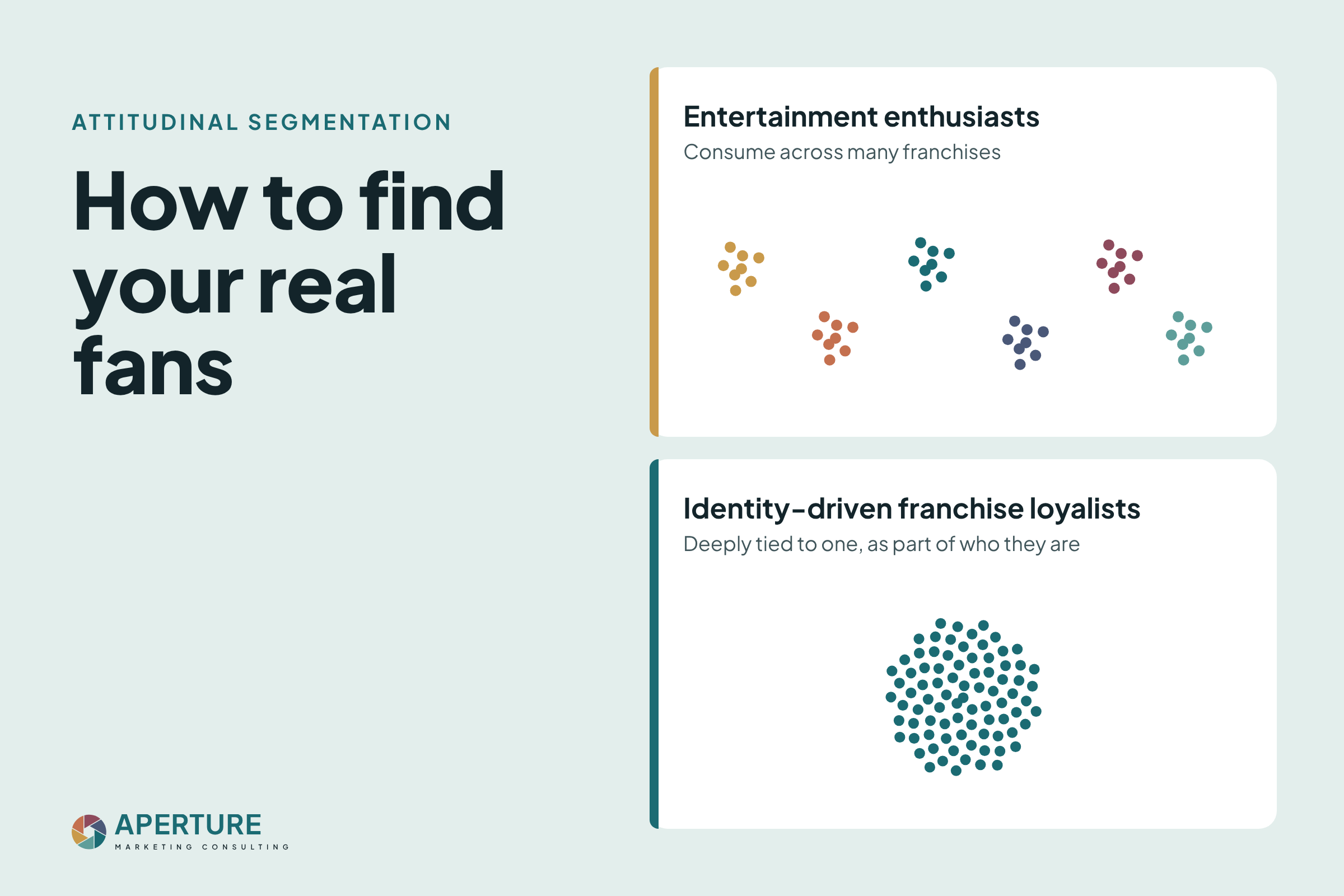
We used those answers in a segmentation model, and it split the franchise’s superfans into two distinct groups.
Entertainment enthusiasts acted like superfans in the sense that they consumed a lot: film, TV series, consumer products, experiences, games and books. But they weren’t loyal to a single franchise. They consumed across many, and this one was just one of them.
Identity-driven franchise loyalists had a deeper emotional connection, one tied to who they are as people. They “badged” with the franchise: they wore its apparel, were more likely to dress up as the characters, and were strongly aligned with the values of the stories and their creator.
On consumption alone, the enthusiasts looked like the superfans. The attitude questions showed that the loyalists were a different kind of fan altogether.
Turning segments into decisions
The two groups wanted different things, and that changed how we expanded the franchise.
The loyalists treated the original stories as their bible. As we extended the universe in content, products, experiences and games, we had to be careful not to upset them. Every new story had to make sense alongside the originals, and every new product had to fit within the stories and make sense in that world.
The enthusiasts cared less about the intricacies and details. They wanted fun entertainment.
You can serve both groups, but the group with more at stake sets the guardrails. I treat the loyalists as the compass, not the target: they tell you where the line is, and everyone else gets great experiences inside it. Without the attitudinal data, we would have seen one group of superfans and missed the segment that could be hurt most by a wrong move.
The same split in everyday brands
Entertainment didn’t invent this split. In any brand with devoted customers, some people like the brand and some people wear it, meaning it’s part of how they see themselves.
Take Whole Foods Market. When I worked there, I built a behavioral segmentation that grouped customers by how they shopped, and we used it to personalize communications. I didn’t run an attitudinal segmentation there, but I can tell you what I’d expect to find. One group would be highly aligned with the idea of food that’s better for people, communities and the world. Another would simply want food that tastes good. The tribe at the center of the brand campaign fits the first group.
That is a hypothesis, not a finding. But it shows what attitudes add: a behavioral view shows two kinds of frequent shopper, and an attitudinal view would show why each one shops there.
Common mistakes
Starting with the statistics, not the decision. A segmentation with no decision behind it ends up as a slide deck.
Creating segments nobody can act on. If you can’t say what you’d do differently for a segment, merge it or drop it.
Creating more segments than a team can use. If people can’t remember them, they won’t use them.
Asking only about product features. The items that separated the two groups above were about identity, values and community, not features.
Treating the segments as permanent. Attitudes shift. Keep asking the same questions over time, ideally in your brand tracker.
When to run it yourself and when to get help
If you already have a research team and a survey platform, you can build a first version yourself with the steps above. Where outside help pays off is in the design (writing the statements that separate real fans), the analysis, and, most of all, turning segments into strategy a leadership team backs. That’s the heart of what I do in Decide, my brand strategy and positioning work.
If you’d like to talk through whether this fits your brand, book a 30-minute consultation.
Frequently asked questions
What is attitudinal segmentation? It’s a way of grouping customers by what they believe and feel about your brand and category, not only by who they are or what they buy.
What’s the difference between attitudinal and psychographic segmentation? Psychographic is the broader term and covers lifestyle, interests, personality and values. Attitudinal focuses on attitudes and beliefs, especially about a specific brand or category. In practice, the two overlap and are often used interchangeably.
What’s the difference between attitudinal and behavioral segmentation? Behavioral segmentation groups people by what they do, such as purchases and frequency. Attitudinal segmentation groups them by what they think and feel. The two work best together.
How many segments should I have? Enough that you’d treat each one differently, and no more than your team can remember and use.