
Updated November 2026
If you’re considering a fractional CMO, the first question is usually about fractional CMO cost. The answer varies a lot, and the people who publish prices are also selling the service. This guide pulls together what five of them publish, explains what moves the price, and shows how to judge what you’re paying for.
The short answer
Published estimates put typical fractional CMO retainers at roughly $5,000 to $15,000 a month, with larger or more hands-on engagements running higher. Hourly rates are quoted at about $150 to $500, day rates at $1,200 to $3,500, and fixed-scope projects at roughly $5,000 to $50,000.
Those figures come from five firms and consultants that sell this work themselves (MarketerHire, Go Fractional, Chatter Buzz Media, Elevarus and Matthew Deal), and a few of them repeat each other’s numbers. Treat them as a rough guide, not a price list. Where a specific engagement lands comes down mostly to two things: the experience of the person you hire, and the scope of the work.
Fractional CMO rates: four ways they charge
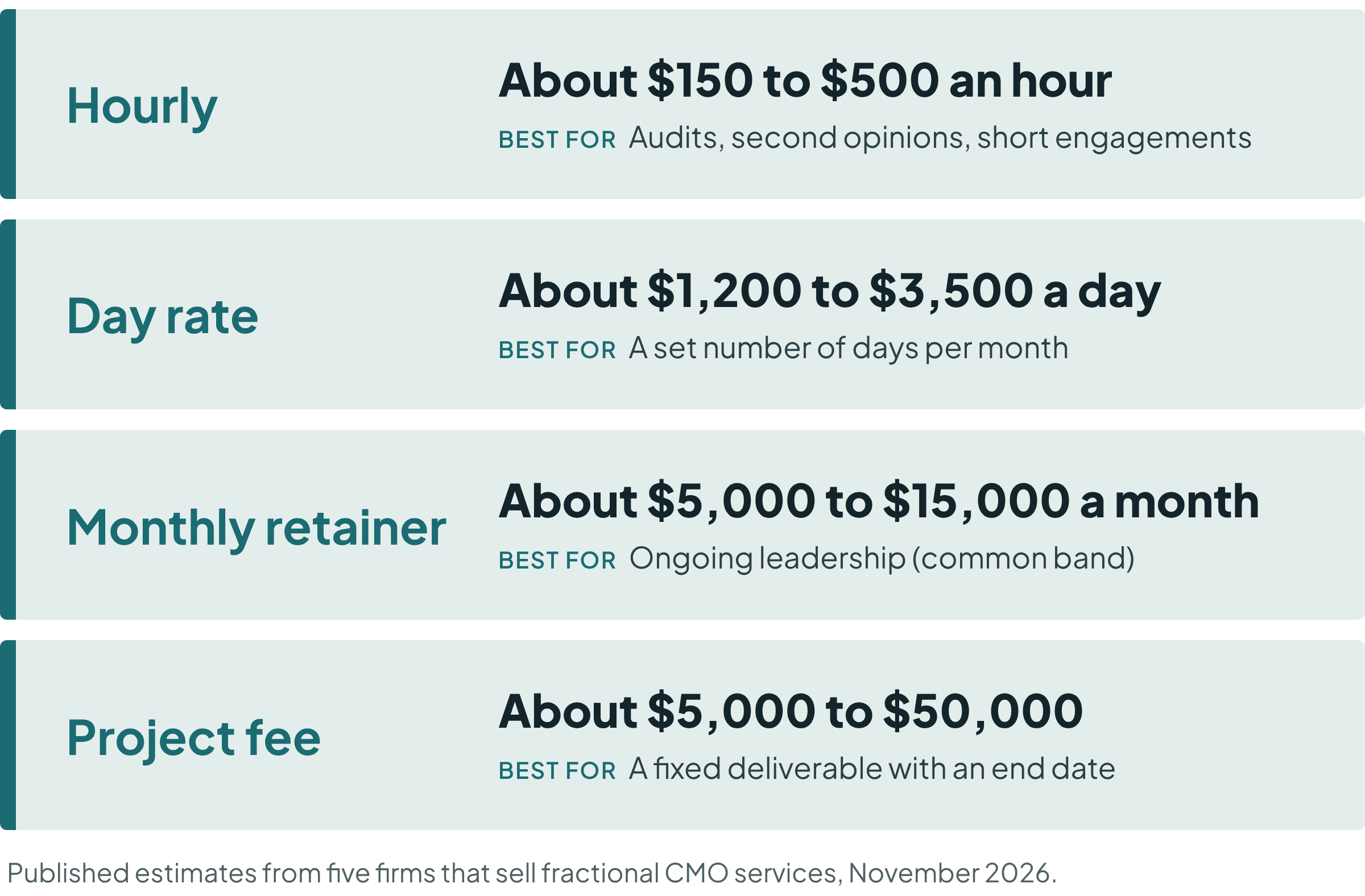
Hourly billing suits a short audit or a second opinion. For ongoing leadership it can work against you, because a running meter discourages the quick calls where good advice often happens.
Day rates tell you exactly what a day costs, which helps when the need is a set number of days per month.
Retainers are the most common structure in the sources, and the number usually reflects how many days or hours per week you’re buying. Chatter Buzz Media ties retainers to company size: $10,000 to $18,000 a month for companies with $10 million to $25 million in revenue, rising to $25,000 to $40,000 or more at $75 million to $200 million.
Project fees make sense when the outcome is clear and has an end date, such as a brand strategy or a launch plan. Only two of the five sources publish a project range, and it’s wide, so scope matters more here than anywhere else.
What drives the cost
Two things matter most.
Experience and expertise. Sources price by track record. MarketerHire quotes $3,000 to $7,000 a month for someone with 8 to 10 years of experience, and $10,000 to $15,000 for 15 or more years with a record of scaling larger businesses. Elevarus, citing another firm, puts 10 to 15 years at $5,000 to $8,000 a month and 20 or more years with exits at $12,000 to $25,000. Three of the five sources also give a figure for specialization: roughly 15 to 30% more for specialized expertise. You’re paying for judgment, which means knowing what to do and what to skip.
Scope. What the person is responsible for matters as much as their résumé. Matthew Deal breaks it into three tiers:
Advisory, about $3,000 to $5,000 a month. Reviewing plans and making recommendations, with no ownership of results.
Strategic ownership, about $5,000 to $10,000 a month. Owning the strategy and directing agencies, roughly 4 to 8 days a month.
Embedded leader, about $10,000 to $15,000 a month. Running the function, roughly 8 to 12 days a month. Above $15,000 he describes executive-level engagements with a heavy cadence.
Other factors move the number too: how much team and budget the role manages, the length of the contract, and the size and stage of the company. Location matters less than you might expect for remote work. Go Fractional notes that virtual CMOs don’t always cost less.
What you get at each level
These tiers are a rough guide, and many engagements start at one level and move to another. At Aperture, my services line up with them:
Decide sits at the advisory end. It’s brand strategy and positioning: where to play, what to stand for, and a plan your leadership team backs.
Launch and Grow sit at strategic ownership. Launch builds a story that earns attention for a brand, product or campaign with a date on the calendar. Grow wins customers at a cost that works and keeps them, with brand and performance in one funnel, plus CRM, loyalty and fandom strategy.
Lead is the embedded end: a working marketing leader for a gap, a first build, or ongoing coverage.
Fractional CMO vs. full-time CMO vs. agency
Full-time. The sources estimate a full-time CMO at about $250,000 to $520,000 a year once benefits, bonuses and recruiting are counted. For average cash pay, Matthew Deal cites about $316,000 (Glassdoor) and about $374,000 (Salary.com).
Fractional. At retainers of $8,000 to $15,000 a month, the annual cost works out to about $96,000 to $180,000, per Elevarus. That’s lower than a full-time hire in year one, but a fractional CMO still needs people or agencies to carry out the plan.
Agency. MarketerHire puts marketing agencies at $5,000 to $25,000 or more a month. An agency typically executes campaigns and channels. A fractional CMO sets direction and holds the agencies and team to it. The two often work together.
What you’re paying for
Because experience drives the price, judge it directly. These questions help:
Has this person built and run the work, or only advised on it? Ask what they did themselves.
Which brands, and at what scale? A big name on a résumé tells you less than the role the person played.
What results can they point to, and what was their part in them?
Do they bring a point of view you can’t get elsewhere? A specialization premium makes sense when the expertise fits your problem. If it doesn’t, shop on scope and price.
What would the first 90 days look like? A good candidate can describe it concretely after one conversation.
When fractional isn’t the right fit
You need daily leadership of a large team. MarketerHire suggests that above roughly $15,000 a month, hiring full-time may make more sense.
Your budget is below what a quality engagement costs. The same source calls anything under $3,000 a month consultant-level advice.
No one is in place to carry out the plan. A fractional CMO sets direction. You still need people or agencies to execute.
The problem isn’t clear yet. Start with a fixed-scope project, such as a strategy or a diagnostic, before committing to a retainer.
How Aperture prices
I work with everyday consumer brands, bringing entertainment storytelling and fandom strategy to the work of turning customers into fans. I price in two ways:
Project work: a fixed scope and fee agreed up front, with clear deliverables and an end date.
Fractional work: scoped by days per week, with a defined focus.
I don’t publish a rate card because every engagement is scoped to what the brand needs. The quickest way to get a number is a conversation.
Frequently asked questions
How much does a fractional CMO cost? Published estimates put common retainers at about $5,000 to $15,000 a month and project fees at about $5,000 to $50,000. The range depends mostly on the experience of the person and the scope of the work.
How many hours a week does a fractional CMO work? Published figures vary widely, from about 8 hours a month for advisory work to 20 hours a week for embedded roles. Retainer tiers are usually described in days: roughly 4 to 8 days a month for strategic ownership and 8 to 12 for an embedded leader.
How long do engagements last? One source says retainers are commonly structured in 12-month increments, with measurable impact expected within 90 to 180 days. Project work ends when the deliverable is done.
Can a fractional engagement turn into a full-time hire? Sometimes. If the work outgrows part-time, a fractional leader can help define the full-time role and hand off to the person who fills it.
Sources
Figures are as published in November 2026. Ranges change, and several sources repeat one another, so verify before relying on a specific number.
MarketerHire: Fractional CMO Cost, What to Budget in 2026
Go Fractional: Fractional CMO Salary and Cost Guide
Chatter Buzz Media: How Much Does a Fractional CMO Cost in 2026?